

Traffic load monitoring: what a structure really carries
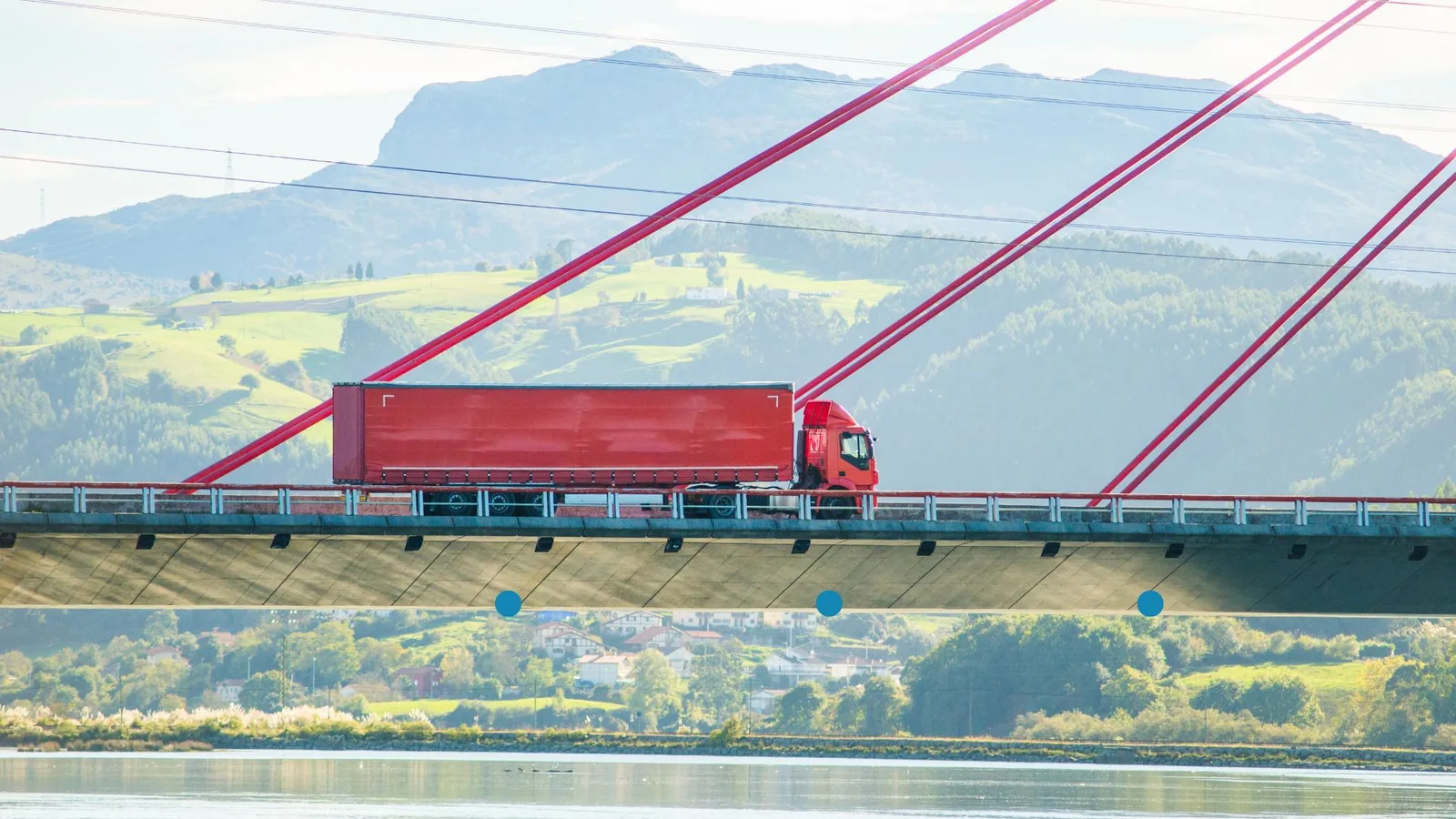
Design relied on the assumptions of the construction period, traffic today is different. The monitoring measures on the structure itself which strain actually arrives there, permanently and with a threshold.
Your benefits
An assumption can be replaced with a measurement
Calculated load assumptions must stay on the safe side. They therefore say what the structure is designed to withstand, not what it experiences every day.
Request a quoteReadings at the point of assumption
Existing structures are designed to the load assumptions of their construction period. The measurement series shows which strain actually reaches the governing cross-section today.
The full load collective, not a single case
For fatigue, what matters is how often and how strongly a component is strained. This frequency distribution only emerges from a continuous measurement over months.
Abnormal loads documented
Announced oversize and heavy-goods transports can be recorded as their own event. What the structure experienced then becomes a fixed data record.
Evidence instead of assumption
Weight restriction, lane guidance, a lorry overtaking ban or replacement construction: the data series carries the decision and makes it traceable for clients and authorities.
How it works
Four steps from a crossing to an answer
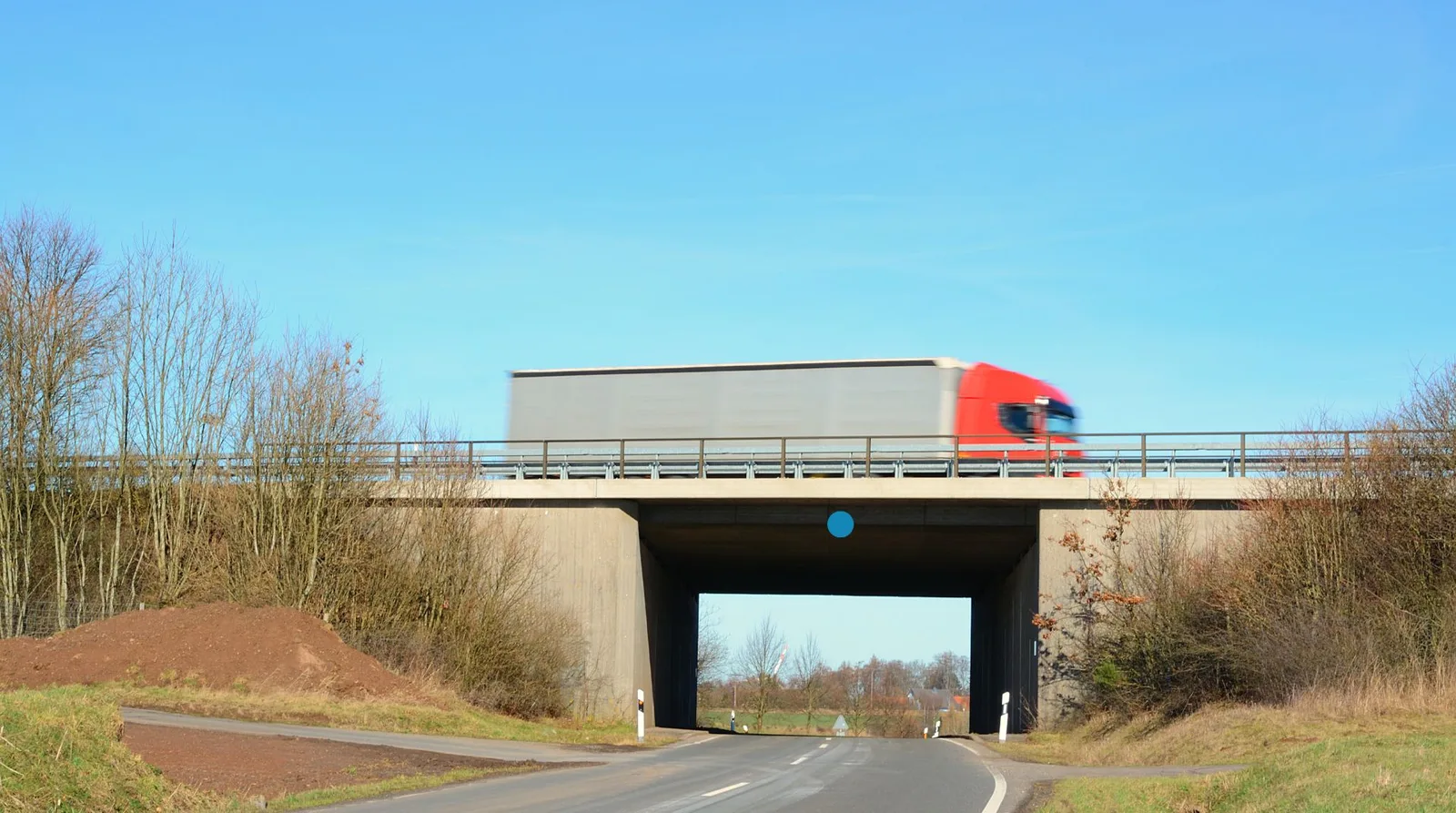
A single crossing says little, it is part of everyday operation. It only becomes meaningful as a series: how often, how strongly, and with what trend over the years.
- 01
Record the structure and the question
We review the structural system, construction type and findings from the last inspection, define the governing cross-section and clarify which decision the measurement is meant to support.
- 02
Capture the structure’s response
What is measured is not the vehicle, but the response of the component: strain, deformation, crack width or vibration. Structure temperature runs alongside, because it shifts the zero point.
- 03
Condense the time series into a collective
The record builds a frequency distribution: how often which strain occurs, at what times of day and week, and how this changes over months.
- 04
Monitor the threshold and notify
A threshold is agreed for the governing quantity. If it is exceeded, notification goes out automatically while the documentation keeps growing in parallel.
Experience the principle
The same bridge, two vehicles
Strain in the governing cross-section rises as the vehicle approaches mid-span and falls again afterwards. The shape of this curve belongs to the structure, its height to the load above it. Switch the vehicle and see the difference.
Threshold utilisation
0%
Measured quantity
Strain, mid-span
Threshold exceeded
Event documented, notification sent to the responsible authority
What is measured
What is measured is the structure, not the vehicle
The load itself remains outside the measurement. What matters is what it triggers in the component, and depending on construction type that is a different quantity.
Steel & composite
Strain on the component
Strain in the governing cross-section is the most direct response to the load above it. Its range of fluctuation and its frequency are the quantities the fatigue question hinges on.
Concrete structures
Crack width & deformation
In concrete, strain shows up in the movement of existing cracks and in deflection. Both can be tracked permanently and to the millimetre.
All construction types
Vibration & natural frequency
How a structure oscillates in response to a crossing depends on its stiffness. If this behaviour changes over years, that is a signal worth investigating.
The individual quantities are also available as a dedicated solution: crack movement in crack monitoring, vibration in vibration monitoring, and all quantities together in structural health monitoring. In the concept phase we combine the quantities that fit your question.
Everything from a single source
One point of contact for the entire monitoring programme
From choosing the governing cross-section through installation to ongoing evaluation in the online portal, we accompany you through the whole project, as a complete solution, not separate parts.
- 01
Concept
We assess the structural system and the question at hand, select the measured quantities and set measuring points and thresholds at the governing cross-section.
Learn more - 02
Installation
On request, we fit the sensors to the component, set them up and commission the monitoring with a documented baseline measurement.
Learn more - 03
Maintenance and operation
We keep the sensors operational, check their function and adjust thresholds if usage or traffic routing changes.
Learn more - 04
Monitoring and alerting
We observe the measurement series continuously, report threshold exceedances and provide the evaluation in the online portal.
Learn more
Typical applications
Where the load is the open question
Whether a structure still tolerates today\u2019s traffic decides between restriction, refurbishment and replacement construction. A measurement series answers the question that otherwise runs on assumptions.
- Existing structures whose load assumptions date from their construction period
- Bridges under reassessment, where an assumption is to be replaced by a measurement
- Steel and composite structures with an open fatigue question
- Structures on heavy-load routes or diversion routes
- Announced oversize and heavy-goods transports over a sensitive structure
- Structures ahead of a decision on restriction, refurbishment or replacement
Reassessment
A measurement at the point of the assumption
When an existing structure is reassessed, the traffic load applied decides the outcome. Structure-specific assumptions are explicitly provided for at the higher levels of reassessment, and a measurement series on the structure is the most robust basis for that.
Structural inspection
The course between two main inspections
Inspection to DIN 1076 remains in place. The monitoring delivers the years in between as a measurement series and shows the inspecting engineer which strains actually occurred during this time.
To the bridge monitoring industryTraffic load monitoring for your structure
Whether a reassessment, a fatigue question or an announced heavy-goods transport, we review the structure and align measured quantities, measuring points and thresholds with your question.
 Christian Steffes
Data platform
All readings on one platform
The sensors transmit their readings wirelessly to the data platform, where they are evaluated, documented and continuously checked against your thresholds.
- AI-assisted data analysis
- User-focused reporting
- Continuous evaluation
- Warning and alarm thresholds
- Alerts by email and text message
- Remote access around the clock
- AI-assisted data analysis Condition within limits
- User-focused reporting Report ready
- Alerting Thresholds monitored
Frequently asked questions about traffic load monitoring
What is traffic load monitoring?
Why is the calculated load assumption not enough?
Does Infrasolute determine axle loads or total weights with this?
Which measured quantities come to my structure?
Does the monitoring replace structural inspection to DIN 1076?
Does the installation require a closure?
Project inquiry
Let's talk about your structure
Tell us about the structure, its year of construction and the question the measurement should answer. You will receive a robust initial assessment at short notice, including suitable measured quantities and measuring points.
+49 6742 8599600 DE +41 41 670 00 11 CH info@infrasolute.com