

Construction vibration monitoring to DIN 4150-3
Construction-stage vibration monitoring with continuous threshold monitoring and automatic alerting. For piling works, demolition, compaction and blasting near sensitive structures.
- Measured quantity Vibration velocity in mm/s
- Measuring directions x / y / z
- Assessment Guidance values of DIN 4150-3
- Threshold set per building type
- Alerting automatic on exceedance
- Transmission LTE-M, without mains power
Why measure
Why construction-stage vibration monitoring is essential
Wherever piling, compacting, demolishing or blasting takes place, vibrations arise that propagate through the ground to neighbouring structures. Continuous construction vibration monitoring makes visible whether the guidance values of DIN 4150-3, the German standard for the effects of vibration on structures, are being kept.
Request a quoteProtect neighbouring buildings
Vibrations can trigger cracks and settlement in third-party buildings. The measurement detects critical values before damage occurs.
Meet the burden of proof
Clients, neighbours and authorities often require objective evidence that the guidance values of DIN 4150-3 are being kept.
Reduce liability
Seamlessly documented measurement data removes the basis for unjustified damage claims and creates clarity.
Bring residents along
Keeping comfort limits to DIN 4150-2 and ISO 2631-2 reduces complaints and increases local acceptance.
React in real time
If the vibration velocity approaches the threshold, the method can be adjusted immediately, instead of hoping afterwards.
Back up the forecast
A preliminary assessment to DIN 4150-1 sets the frame. Only the measurement proves that it is actually kept during operation.
Simulation
The guidance value decides when an alert is raised
The central measured quantity is the vibration velocity in mm/s. Choose the building type and trigger an event. If an event exceeds the guidance value of DIN 4150-3, the system switches immediately to alarm.
Threshold exceeded
Alert sent by email & SMS
Guidance values
The guidance values of DIN 4150-3 at a glance
For short-term vibrations such as pile driving impacts, demolition or blasting, DIN 4150-3 specifies graduated guidance values for the vibration velocity. If they are kept, the standard indicates that no damage is to be expected.
| Building type (Table 1) | Foundation 1 to 10 Hz | Foundation 10 to 50 Hz | Foundation 50 to 100 Hz | Top floor, horizontal |
|---|---|---|---|---|
| Commercial and industrial buildings | 20 mm/s | 20 to 40 mm/s | 40 to 50 mm/s | 40 mm/s |
| Residential buildings and comparable structures | 5 mm/s | 5 to 15 mm/s | 15 to 20 mm/s | 15 mm/s |
| Particularly sensitive, heritage-worthy structures | 3 mm/s | 3 to 8 mm/s | 8 to 10 mm/s | 8 mm/s |
The values at the foundation increase linearly within the frequency interval. At the top floor level, a frequency-independent value applies for the horizontal vibration velocity.
All three parts of the standard explained in detail in the knowledge article "DIN 4150 explained clearly".
To the DIN 4150 guide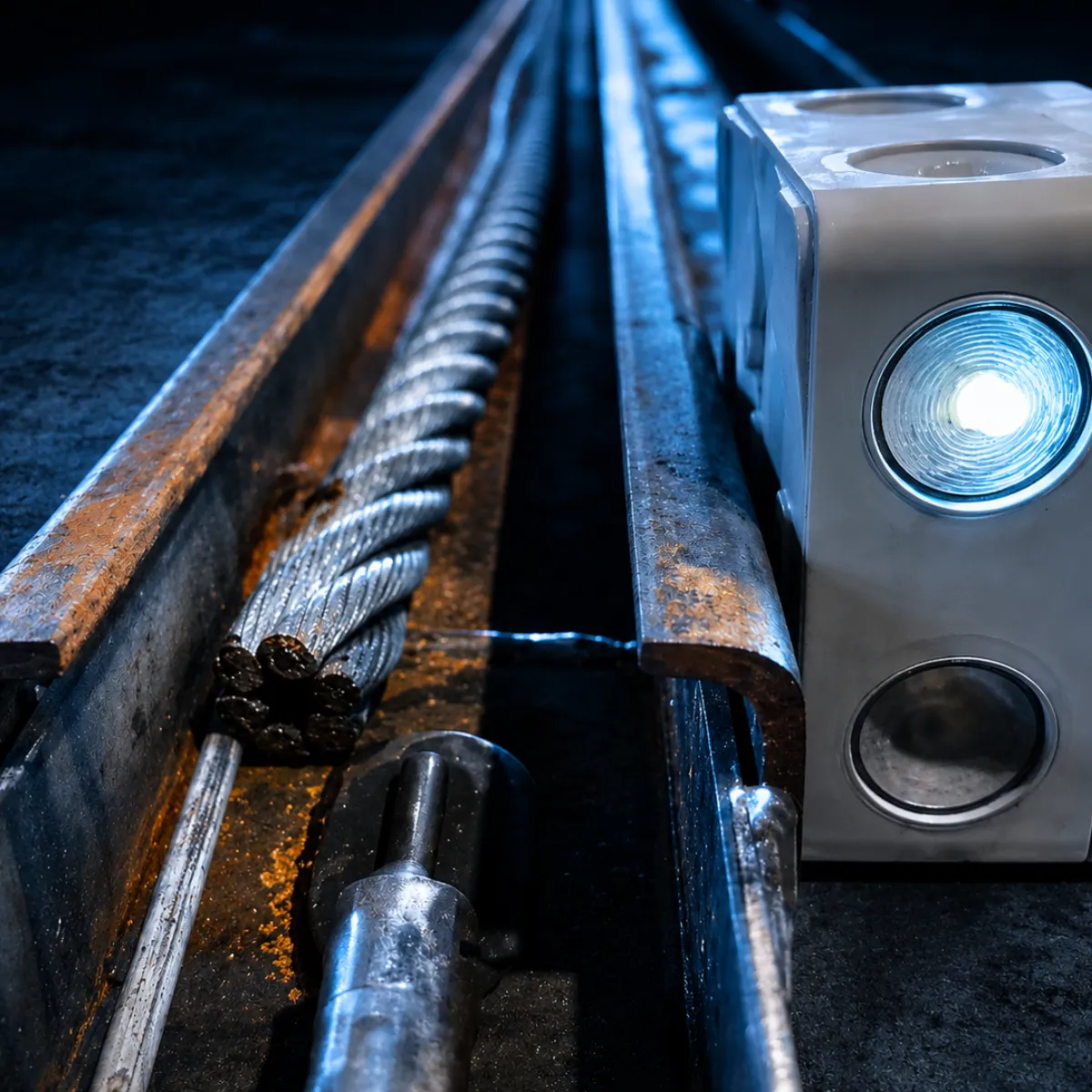
Measuring principle
How the measurement to DIN 4150-3 proceeds
The measurement is taken at the structure to be protected, not at the source of the vibration, because the standard assesses the effect, not the cause. The sensors capture the vibration velocity in all three spatial directions and additionally assign a frequency to each event. Only this combination allows comparison with the frequency-dependent guidance values.
- 01
Determine measuring points
Sensors are fitted to the foundation and, where relevant, to the top floor level of the affected structure.
- 02
Capture continuously
The sensor measures the vibration velocity event-based around the clock and stores every relevant event with a timestamp.
- 03
Check threshold
Every event is checked against the stored guidance value and the associated frequency.
- 04
Alert automatically
If a value approaches or exceeds the threshold, an alert is sent immediately by email and SMS to those responsible.
Technology
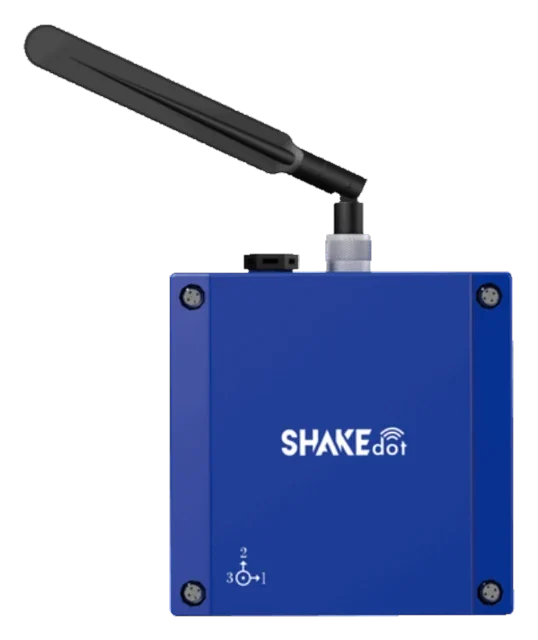
The IoT vibration sensor
Compact, self-sufficient and robust for use on construction sites.
- Sensor
- 3-axis MEMS, ±2 g
- Frequency range
- DC to 500 Hz, 250 Hz sampling
- Measuring range
- PPV 0 to 60 mm/s
- Transmission
- LTE-M & NB-IoT, MQTT
- Storage
- 32 GB internal
- Runtime
- up to 6 months (battery)
- Housing
- 100 x 100 x 60 mm
- Extra
- Integrated temperature measurement
The device behind these values is the vibration sensor SHAKEdot. Its product page has the housing, mounting and data transmission in detail.
Everything from a single source
From the monitoring concept to ongoing monitoring
You receive construction vibration monitoring as a complete service, not as individual parts. One point of contact is responsible for the entire process.
Concept
We determine measuring points, guidance values and sensors, matched to the structure, the method and the standard.
Learn moreInstallation
The wireless sensors are fitted without running cables and without mains power, and commissioned with a documented baseline measurement.
Learn moreMaintenance and operation
We operate the measuring chain throughout the entire critical construction phase and keep it reliably available.
Learn moreMonitoring and alerting
Continuous threshold monitoring with automatic alerting and traceable documentation.
Learn moreApplication areas
Typical reasons for construction vibration monitoring
Wherever energy is introduced into the ground and sensitive or third-party structures stand nearby.
Temporary or permanent
Construction vibration monitoring or vibration monitoring?
Both approaches measure vibration, but pursue different goals. Construction vibration monitoring accompanies a construction phase, vibration monitoring permanently monitors a structure or a facility.
Construction vibration monitoring
Construction-stage & temporary
- Tied to a specific construction phase
- Focus on short-term vibration to DIN 4150-3
- Threshold monitoring with instant alerting
- Documentation for clients, neighbours and authorities
Vibration monitoring
Permanent & long-term
- Monitoring over years instead of weeks
- Focus on structural health and trends
- Detects gradual changes to a structure or facility
- For existing structures and industrial plants
Construction vibration monitoring for your project
Tell us about the method, nearby buildings and the time frame. We recommend measuring points and guidance values and get back to you shortly with a no-obligation quote.
 Peter Nater
Data platform
All readings on one platform
The sensors transmit their readings wirelessly to the data platform, where they are evaluated, documented and continuously checked against your thresholds.
- AI-assisted data analysis
- User-focused reporting
- Continuous evaluation
- Warning and alarm thresholds
- Alerts by email and text message
- Remote access around the clock
- AI-assisted data analysis Condition within limits
- User-focused reporting Report ready
- Alerting Thresholds monitored
Frequently asked questions about construction vibration monitoring
When is construction vibration monitoring to DIN 4150 required?
What exactly is captured during the measurement?
What happens if a guidance value is exceeded?
Does the sensor need to be connected to mains power?
Where is the sensor fitted, at the source or at the building?
Do I receive documentation of the measured values?
Project inquiry
Construction vibration monitoring for your project
Tell us about the method, nearby buildings and the time frame. We recommend measuring points and guidance values and get back to you shortly with a no-obligation quote.
+49 6742 8599600 DE +41 41 670 00 11 CH info@infrasolute.com