
Track monitoring to RIL for safe rail infrastructure
During construction work next to and beneath tracks, we monitor track position, settlement and deformation to the standard of RIL 883.8100A01. With automatic data capture, remote transmission and proactive alerting.
- Position nominal
- Height nominal
- Cant nominal
- Twist nominal
Why track monitoring
Why track monitoring is essential during construction work
Construction work near the track, temporary conditions and interventions in the subsoil can cause settlement, displacement and twist. Compliant geo-monitoring provides evidence and enables a fast response.
Request a quoteConstruction near the track
Continuous recording of track geometry during construction states directly next to or beneath the track.
Drilling and piling works
Interventions in the subsoil cause settlement. The smallest changes in position are detected early.
Temporary bridges
Monitoring of position, cant and twist on temporary structures in the track area.
Switches and crossings
Geo-monitoring for tracks and switches to RIL requirements, even at sensitive junctions.
Traceability
Unbroken time series document the track condition before, during and after the construction phase.
Automatic alerting
If thresholds are reached, the system alerts immediately, around the clock and without an on-site check.
RIL 883.8100A01
These are the parameters required by the guideline
RIL 883.8100A01, Deutsche Bahn’s guideline for track monitoring, defines minimum requirements for measurement and evaluation in geo-monitoring of tracks and switches. At least four parameters are monitored, and the scope can be extended as part of the risk assessment.
- 01
Position
Lateral position of the track, captured via measuring points on the sleeper grid.
- 02
Height
Vertical position of the rail, to reliably detect settlement and heave.
- 03
Relative height (cant)
Height difference between the two rails, decisive for running safety.
- 04
Twist
Change in cant over a defined length, a key safety criterion.
Measuring point density
Every 5 sleepers per rail, typically 3.00 m at a 60 cm spacing.
Measuring range
At least 25 m beyond the area of possible change.
Extendable
Gauge and absolute track geometry depending on the risk assessment.
Simulation
Detect settlement before it becomes critical
Subsoil interventions cause the track to sag. See how the height position is measured continuously and what happens once the defined threshold is reached.
Demonstration only
Readings, measuring point M4
Continuous capture, 15 min cycle
- Position 0.0 ok
- Height (settlement) 0.0 ok
- Cant 0.0 ok
- Twist 0.0 ok
Threshold reached, alarm triggered
Notification sent to site management and operator
Measurement technology
Total-station monitoring as the standard
For track monitoring to RIL requirements, high-precision total-station monitoring is the standard approach. Precise, automated and with continuous remote transmission.
Capture
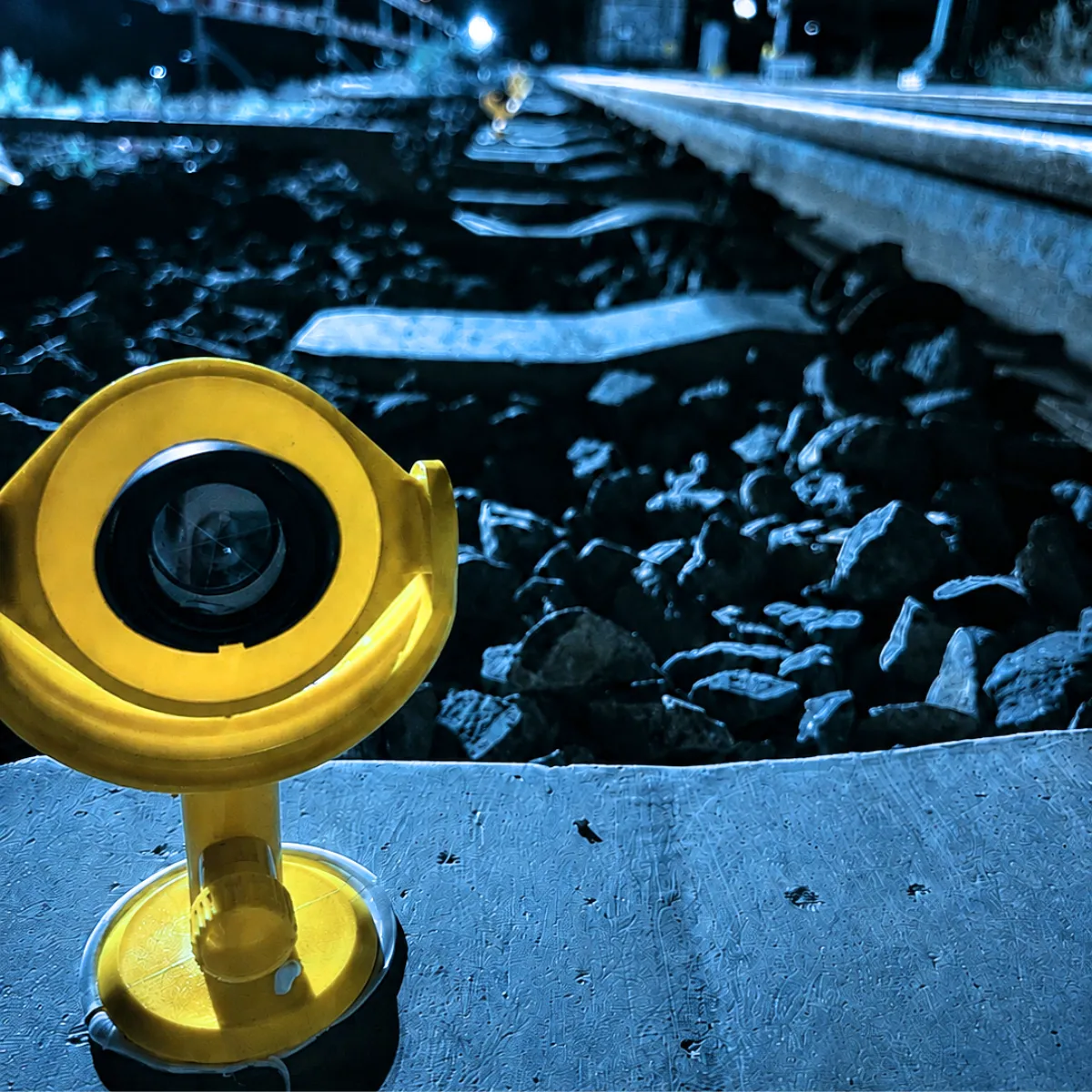
Prism targets on the sleeper grid
Reflector targets are placed on the specified grid and automatically sighted by the motorised total station.
Evaluation
Automated measurement cycles
Defined measurement intervals deliver a robust evaluation of track geometry without manual intervention on site.
Operation
Remote transmission and alerting
All readings are transmitted securely and continuously checked against the defined thresholds. If a threshold is exceeded, alerting is triggered automatically.
Everything from a single source
One point of contact for the entire track monitoring project
You don\u2019t get separate parts, you get a complete solution. From the monitoring concept to ongoing operation, everything is handled in one place.
- 01
Concept
Defining parameters, thresholds and the measuring-point grid according to RIL and the risk assessment.
Learn more - 02
Installation
Prism targets and the total station are installed correctly and commissioned with a documented baseline measurement.
Learn more - 03
Maintenance and operation
Continuous measurement cycles, well-maintained sensors and robust evaluation throughout the entire critical phase.
Learn more - 04
Monitoring and alerting
Round-the-clock remote transmission, automatic alerting on thresholds, on request as an outsourced department.
Learn more
A monitoring concept for your construction project at the track
Tell us about your project in the track area. We will propose an RIL-compliant monitoring concept and get back to you shortly with a no-obligation quote.
 Roman Koch
Data platform
All readings on one platform
The sensors transmit their readings wirelessly to the data platform, where they are evaluated, documented and continuously checked against your thresholds.
- AI-assisted data analysis
- User-focused reporting
- Continuous evaluation
- Warning and alarm thresholds
- Alerts by email and text message
- Remote access around the clock
- AI-assisted data analysis Condition within limits
- User-focused reporting Report ready
- Alerting Thresholds monitored
Applications
Where track monitoring shows its strength
Wherever construction work can affect track geometry, continuous geo-monitoring provides safety and traceability.
- Construction near the track
- Bridges with individual support points
- Subsoil interventions
- Drilling and piling works
- Temporary bridges
- Switches and crossings
Monitoring for rail operators, train operating companies and engineering offices
Whether a construction firm, an operator or a planning office: we combine track monitoring and RIL expertise for everyone involved in the rail environment.
Frequently asked questions about track monitoring
Which parameters must be monitored as a minimum?
At what spacing are measuring points placed?
How large does the measuring range need to be?
Why is total-station monitoring the standard?
When is additional gauge monitoring required?
Does Infrasolute also take care of ongoing operation?
Project inquiry
A monitoring concept for your construction project at the track
Tell us about your project in the track area. We will propose an RIL-compliant monitoring concept and get back to you shortly with a no-obligation quote.
+49 6742 8599600 DE +41 41 670 00 11 CH info@infrasolute.com