Concrete maturity monitoring: insight into the curing process
Temperature, maturity and strength straight from the component. Data-based decisions instead of estimates, from the construction phase through to operation.
Building constructionInfrastructurePrecast elementsIn-situ concrete
When the formwork-striking time dictates the construction schedule
Temperature, maturity and strength straight from the component turn a guess into a decision. That shortens waiting times, secures quality and documents itself along the way.
Strip formwork up to several days earlier, because the release is based on measured data rather than table values.
Faster construction progress
Construction schedules become plannable because strength development is reliably forecast.
Lower risk
Decisions are based on real measured data from the component rather than estimates.
Real-time data
Temperature, maturity and strength are retrievable at any time, on any device.
Automatic documentation
All measuring points are logged without gaps, auditable and tamper-proof.
Transparency
Clients and site management receive traceable reports at all times.
Winter construction
Monitoring keeps running even at critical temperatures and in severe frost.
Flexible deployment
Suitable for in-situ concrete, precast elements, bridges, tunnels and complex infrastructure projects.
Traditional or digital
The formwork-striking time can be measured
The traditional approach works with table values and safety margins. The temperature in the component instead delivers the maturity and from that the strength, specific to this exact pour.
Traditional approach
Where the effort arises today
Uncertainty about the optimal formwork-striking time
Weather-dependent curing without real-time data
Manual documentation, error-prone and time-consuming
Delays from conservative waiting times
No central overview across multiple sites
With monitoring
What the measurement takes over
Sensors deliver temperature directly from the component
Automatic data capture, around the clock
Live evaluation in the dashboard, anytime and anywhere
Earlier, data-based release of the construction phase
Overview of all projects at a glance
How it works
Four steps to a data-based release
The sensor sits in the component and measures the temperature exactly where the concrete is curing. Everything else is calculated by the system and made available in the dashboard.
01
Install sensors
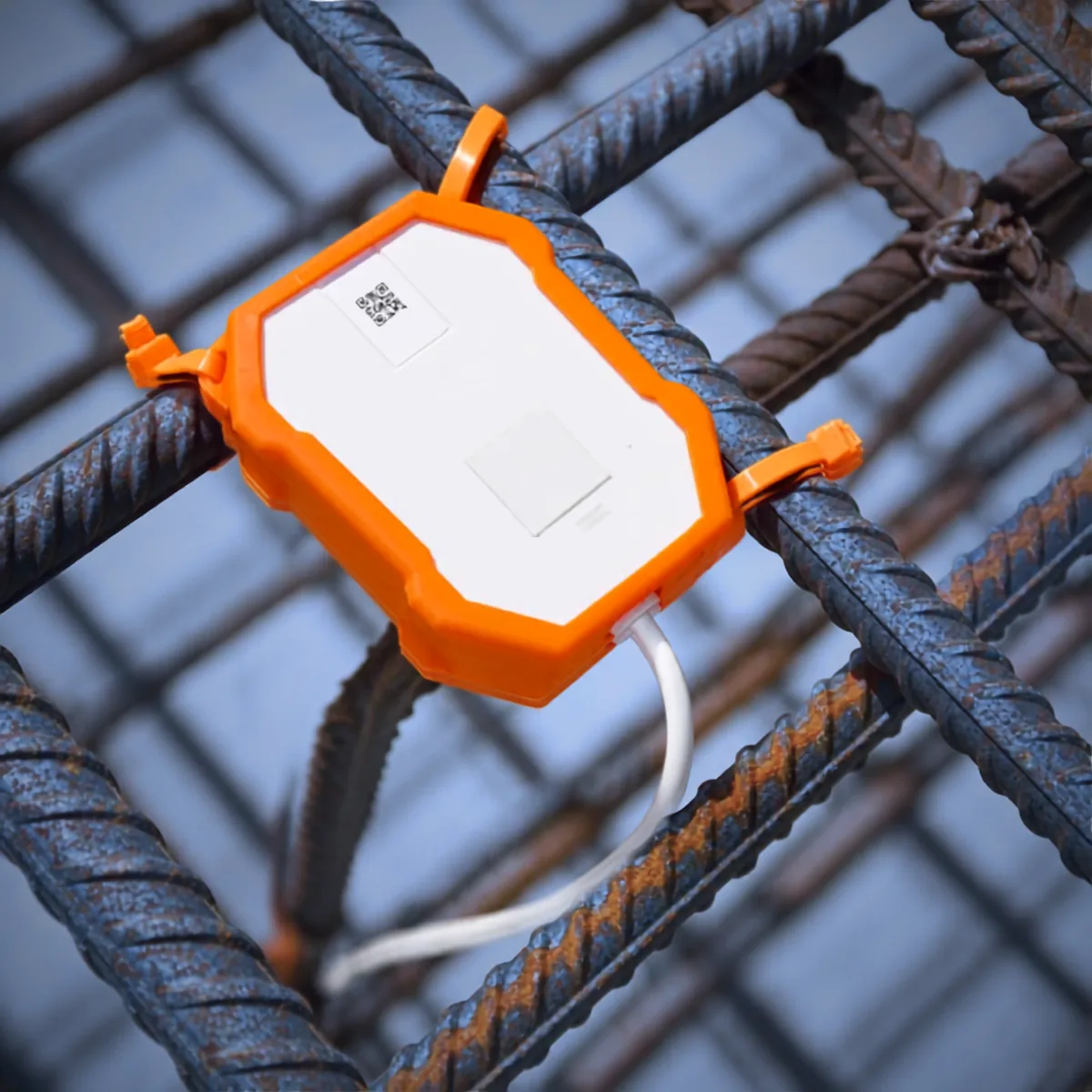
Nova, Nova Split or Gaia 300 are placed in the component during concreting and continuously measure the temperature inside the concrete.
02
Calculate maturity
From the temperature history, the system automatically calculates the concrete maturity using the recognised method.
03
Derive strength
Based on a calibration of your concrete mix, the strength development is estimated in real time.
04
Dashboard and alerts
All data is visible on the web, alerts inform you about the right formwork-striking time.
Sensor selection
Two sensor lines for two project sizes
For fast, uncomplicated projects on site, Nova and Nova Split are ready to go, for large projects with fully automatic cloud connectivity, the Gaia 300. Which sensor fits your component is clarified during the concept phase.
Large and long-term projects
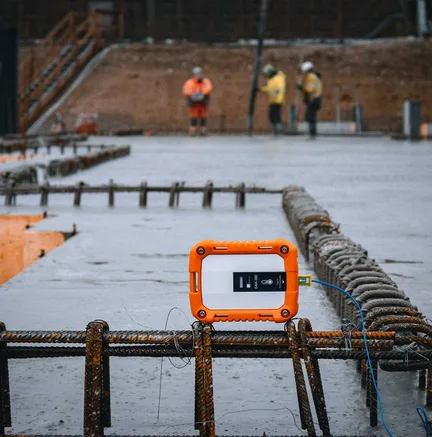
Gaia 300: reusable and cloud-connected
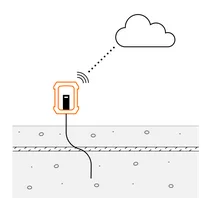
A thermocouple is embedded in the component and connected to the reusable Gaia transmitter. The transmitter transmits the data fully automatically into the cloud via mobile network, without anyone on site.
Reusable transmitter, low cost per measurement
Remote access to all data from the cloud
Individually adjustable cable lengths
Ideal for large concrete pours, bridges, tunnels and areas with restricted access
Cable routing is needed at the component.
Small and medium projects
Nova and Nova Split: plug-and-play
Nova is the straightforward entry point into concrete monitoring: plug in, cast in concrete, done. The data is read directly on site via the app. Nova Split is suitable for foundations, walls and mass concrete with three measuring points.
Plug-and-play, without complex installation
Immediate temperature and strength values via the app
Ideal for slabs, decks, foundations and fast-moving projects
Entry point even without prior experience
Single-use sensor, it remains in the concrete. Readout requires presence on site.
Data transmission
Three ways to the measured data
From manual to fully automatic into the cloud. The difference decides who needs to go to the site for the data.
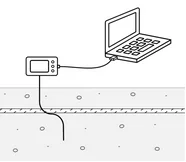
Classic data logger
Manual, via cable and USB
The data is read directly at the logger via a USB cable. This requires physical access to each sensor, and the raw data is then evaluated manually, usually in a spreadsheet.
Nova and Nova Split
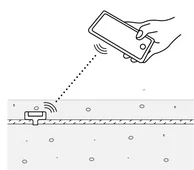
Local wireless via Bluetooth and NFC
The Nova sensor connects directly with the smartphone via the app: plug-and-play, without cables and without complex installation. Temperature and strength are available immediately on site. Ideal for slabs, decks and smaller to medium concrete pours.
Gaia 300
Recommended
Automatic to the cloud via GSM and IoT
The Gaia 300 continuously transmits the measured data into the cloud via mobile network. Presence on site is not required, the data is retrievable through the dashboard at any time. The first choice for large projects and hard-to-reach components.
Automatic calculation instead of spreadsheets
Classic data loggers only deliver raw data. Maturity and strength have to be calculated manually by formula, time-consuming and error-prone.
Infrasolute calculates everything automatically based on the measured temperature history and shows the results in real time in the dashboard, from any device and anywhere.
Calculation
Manual in a spreadsheet, by formula
Real time, automatic
Data access
On site only
Anywhere, anytime
The maturity method
Scientifically grounded, explained in practical terms
The maturity method is based on the physical finding that concrete with an equivalent temperature history reaches a comparable early strength, independent of the outside temperature.
Maturity is the product of time and temperature (TTI). After a one-off calibration of your concrete mix, the current strength can be inferred directly from the measured maturity.
Standard-compliant and individually calibratable
Measured
Temperature + time
Sensor in the component
Calculated
Maturity (TTI)
Time-Temperature Index
Derived
Concrete strength
Real-time forecast (MPa)
The dashboard
All measuring points in one place
Floor plan view with the measuring points, live values per component and automatic alerting. Select a measuring point and see what is coming in there.
Infrasolute portal4/5 online1 alert
ProjectNordpark office building, shell construction ground floor 3 1 1
Target value reached
MS-01, Column A1
Installed 72 h ago · Concrete C30/37
Temperature
23.1 °C
+0.2 °C
Maturity
2,100 °C·h
Strength
36.5 MPa
Progress to formwork-striking time100 %
Formwork-striking strength 30 MPa reached
Target value reached
MS-02, Slab, bay 1
Installed 72 h ago · Concrete C30/37
Temperature
21.4 °C
+0.2 °C
Maturity
1,900 °C·h
Strength
33.8 MPa
Progress to formwork-striking time100 %
Formwork-striking strength 30 MPa reached
Curing
MS-03, North wall
Installed 72 h ago · Concrete C30/37
Temperature
21.0 °C
+0.2 °C
Maturity
1,380 °C·h
Strength
25.5 MPa
Progress to formwork-striking time85 %
Target: 30 MPa
Target value reached
MS-04, Foundation B2
Installed 72 h ago · Concrete C30/37
Temperature
24.3 °C
+0.2 °C
Maturity
2,340 °C·h
Strength
38.8 MPa
Progress to formwork-striking time100 %
Formwork-striking strength 30 MPa reached
Alert: frost risk
MS-05, East wall
Installed 24 h ago · Concrete C30/37
Temperature
3.2 °C
Frost
Maturity
795 °C·h
Strength
16.8 MPa
Progress to formwork-striking time56 %
Target: 30 MPa
Live values for temperature, maturity and strength
Interactive floor plan with all measuring points
Alerting by email and SMS
Tamper-proof reports and export
Role-based team access
Project, measuring points and values in this view are an example. How many measuring points your component needs and which thresholds apply follows from the concept phase.
Everything from a single source
One point of contact for the entire pour
From selecting the measuring points through installation during concreting to ongoing evaluation in the portal, we accompany the project as a complete solution.
In building construction, formwork striking can be released several days earlier as soon as the measured strength development reaches the required value.
Winter construction
Safety during winter temperatures
During a frost period, monitoring runs around the clock. Alerts prevent premature formwork striking.
Precast plant
Digital documentation for clients
In the precast plant, the dashboard logs all curing processes without gaps. Reports can be handed over directly, tamper-proof and verifiable.
After curing
Protecting concrete long-term
Formwork striking ends the construction phase, not the exposure. Moisture penetrates, chlorides travel with it, and in the end there is corrosion of the reinforcement. The CorroDec 2G measures both permanently in the component, wirelessly, batteryless and maintenance-free: the moisture sensor as an early indicator, the corrosion sensor as confirmation.
Both can be installed during concreting, in the same work step as the sensors for curing.
Anyone who needs moisture, corrosion, cracks and movement not individually but as an overall picture of the structure will find them brought together in concrete monitoring.
Tell us the component, the concrete mix and the required formwork-striking strength. We align the sensor line, measuring points and thresholds with your project.
The sensors transmit their readings wirelessly to the data platform, where they are evaluated, documented and continuously checked against your thresholds.
Frequently asked questions about concrete maturity monitoring
What is concrete maturity monitoring?
Concrete maturity monitoring refers to the continuous, digital monitoring of the curing process of concrete using sensors placed directly in the component. The sensors measure the temperature inside the concrete, providing the basis for calculating maturity and strength development in real time.
How does the maturity method work?
The maturity method uses the physical relationship between time and temperature during the hydration of cement. The Time-Temperature Index (TTI), i.e. the maturity, is calculated from the temperature history. A one-off calibration allows the strength to be inferred from it.
Can concrete strength really be monitored in real time?
Yes. After calibrating the relationship between strength and maturity, the system delivers a forecast of strength development in real time. It is a calibrated estimate based on the measured temperature history, not a test on a sample specimen.
How does the monitoring help specifically with formwork striking?
The system shows in real time whether the concrete has reached the necessary minimum strength. This avoids conservative waiting times and lets you set the formwork-striking time based on data, often significantly earlier and more safely than with standard table values.
Is the solution suitable for in-situ concrete and precast elements?
Yes. The monitoring is suitable both for in-situ concrete on site and for precast plants. Precast manufacturers particularly benefit from shorter turnaround times.
How am I warned about critical temperatures?
In the dashboard you define project-specific thresholds. If a value falls below or exceeds a threshold, the system automatically triggers notifications by email or SMS to you and your team.
Project inquiry
Let's talk about your pour
Tell us about the component, the construction schedule and the time you want to strike formwork. You will receive a prompt assessment of which sensor line fits and how many measuring points make sense.