

Deformation monitoring: detect deformation as it happens
Permanently monitor parapets, guardrails, rockfall nets and retaining walls. Deformation from impact, material fatigue or slope movement is detected and reported immediately, even on long and remote sections.
Your benefits
An impact doesn't report itself
A deformed protective structure no longer works the way it was designed to. If you only find the damage at the next patrol run, you lose the time in between.
Request a quoteEven remote sections stay in view
Long sections and hard-to-reach areas are monitored permanently, without anyone needing to drive out regularly. Patrols can then be based on where something actually happened.
Immediate alert
As soon as a deformation occurs, for example from an impact, the system triggers the alert. Minutes pass between the event and awareness, instead of the time until the next patrol.
Retrofittable on existing installations
The sensors can be retrofitted to existing guardrails, barriers and rockfall nets. No rebuild or conversion of the protective structure is needed.
Objective data series
Continuous measurement delivers data on the real behaviour of the components under traffic loads and environmental influences. This is the basis for condition-based maintenance instead of interval-based servicing.
How it works
Four steps from movement to alert
The monitoring system is designed to detect deformation in real time and trigger an alert as soon as a deformation occurs. Which sensors are used depends on the component.
- 01
Define measuring points
We determine which components and sections are monitored and align the sensors with the hazard pattern: impact, material fatigue, settlement or slope movement.
- 02
Capture change in position
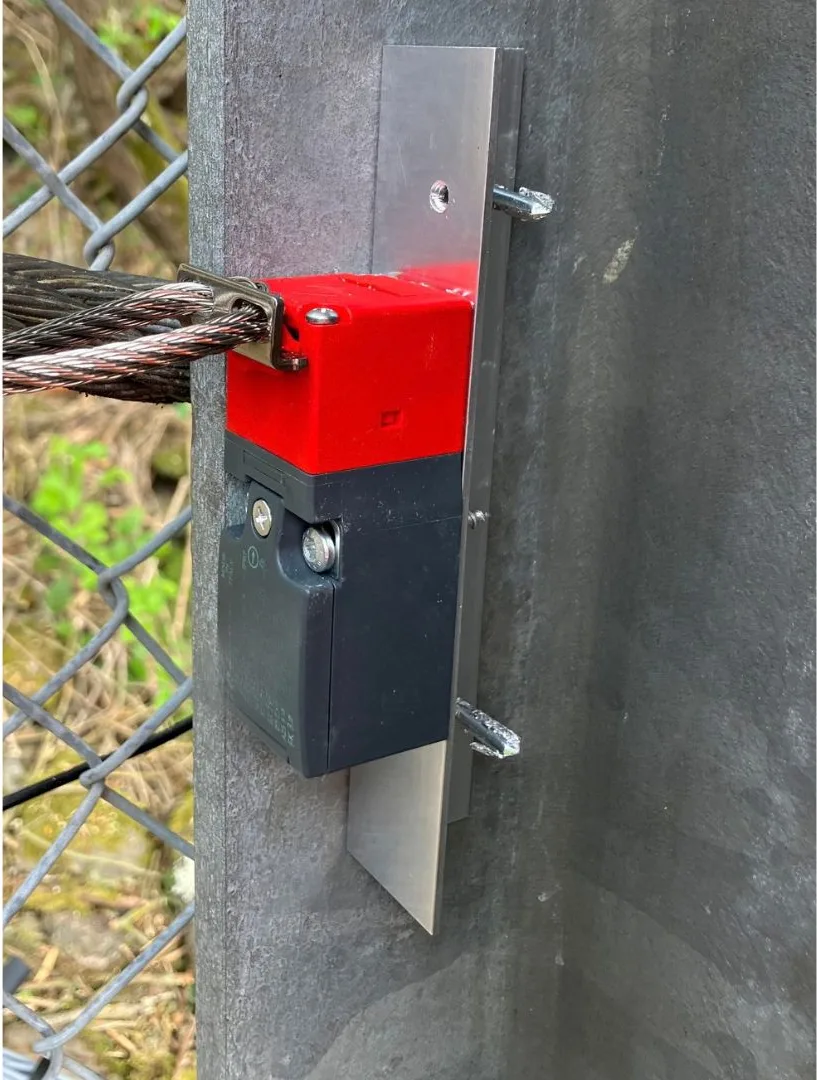
The sensors are connected to the component and permanently capture displacement and deformation. On rockfall nets, measurement runs via cable extension sensors on the wire rope, on components via a sensor on the component itself.
- 03
Check against threshold
Every reading is checked against the stored threshold. This keeps normal movement from temperature and traffic inconspicuous, while only the relevant change stands out.
- 04
Alert and documentation
If the threshold is exceeded, the alert goes out immediately. In parallel, the data series keeps growing and documents seamlessly when something changed.
Experience the event
When a vehicle hits the guardrail
An impact deforms the beam and reduces its protective effect. Start the scenario and see how the sensor captures the deformation and triggers the alert.
Deformation
0mm
Section
Post 14, km 4.7
Threshold exceeded
Deformation detected, alert sent to the control centre
What is monitored
Three component groups, one measurement principle
What all three have in common is that a change in position reduces the protective or load-bearing effect without it being noticeable from the outside.
Road safety
Guardrails & Barriers
An impact deforms the protective structure and reduces its effectiveness, often without the party responsible reporting it. The deformation is detected and reported before the next vehicle movement meets it.
Rockfall
Rockfall nets & rock faces
A rockfall net keeps falling rock away from roads and railways, but in doing so loses capacity. Cable extension sensors on the wire rope report the event, so the net can be emptied and inspected in a targeted way.
Structure
Retaining walls & components
Displacement on retaining walls, cantilever walls and load-bearing components develops slowly. Continuous measurement separates uncritical movement from structural change.
Deformation is one of several measured variables. Tilting and settling is captured by tilt monitoring, crack progression in the component by crack monitoring. On retaining walls and load-bearing structures we combine them in the concept.
Single source
One point of contact for the whole monitoring project
From assessing the section through installation to ongoing evaluation in the online portal, we support you through the entire project, as a complete solution, not individual parts.
- 01
Concept
We assess the component and hazard pattern, define measured variables and thresholds, and plan the sensors to match the section.
Learn more - 02
Installation
On request, we fit the sensors to the guardrail, barrier, net or component and commission the monitoring system.
Learn more - 03
Maintenance and operation
We keep the sensors operational, check their function and adjust thresholds when usage changes.
Learn more - 04
Monitoring and alerting
We continuously observe the deformation and report every event immediately to the responsible party.
Learn more
Typical applications
Where damage can stay undetected for a long time
The less often a patrol passes by, the greater the time during which a deformed protective structure has already lost its effect.
- Guardrails at accident hotspots and in curve sections
- Bridge parapets and protective structures on bridges
- Rockfall nets over roads and railway lines
- Retaining walls, cantilever walls and slope securing structures
- Long sections without regular patrol runs
Route operation
Patrols by event, not by calendar
When the sensors report where something happened, patrols follow accordingly. This saves trips over unremarkable sections and shortens the time to repair at the location that actually needs it.
Slope protection
Rockfall nets and rock faces combined
On the rock face, displacement transducers capture crack movement, on the net, cable extension sensors capture the absorbed event. Together, they show whether the hazard is developing or whether it was a single event.
To the Slopes, Terrain & Guardrails industryDeformation monitoring for your route
Whether guardrail, bridge parapet, rockfall net or retaining wall, we assess the section and align sensors and thresholds with the hazard pattern.
 Peter Nater
Data platform
All readings on one platform
The sensors transmit their readings wirelessly to the data platform, where they are evaluated, documented and continuously checked against your thresholds.
- AI-assisted data analysis
- User-focused reporting
- Continuous evaluation
- Warning and alarm thresholds
- Alerts by email and text message
- Remote access around the clock
- AI-assisted data analysis Condition within limits
- User-focused reporting Report ready
- Alerting Thresholds monitored
Frequently asked questions about deformation monitoring
What is deformation monitoring?
What is the difference to tilt monitoring?
Can monitoring be retrofitted to an existing guardrail?
How quickly do I learn about an impact?
How is a rockfall net monitored?
What happens to the measurement data?
Project inquiry
Let's talk about your route
Tell us about the section and the critical points. You will receive a reliable initial assessment at short notice, including suitable measured variables and sensors.
+49 6742 8599600 DE +41 41 670 00 11 CH info@infrasolute.com