

A damage that comes from within
Stress corrosion cracking, abbreviated SCC after the English term, is one of the most unpleasant damage mechanisms in prestressed-concrete construction. It does not arise from a single cause but from the coincidence of two conditions: a sustained mechanical tensile stress in the steel and a corrosive medium such as chlorides or moisture.
Each of the two conditions on its own would be manageable. Together, they cause microscopically small cracks to form in the steel, which keep growing slowly. This happens over months, often over years, and it happens hidden inside the structure.
Why prestressed-concrete bridges are particularly affected
Prestressing steel is, by design, under high prestress. This prestress is exactly the first condition for stress corrosion cracking, and it cannot be removed, it is the load-bearing principle of the structure. If the second condition is added, meaning moisture or chloride from winter road maintenance, both conditions are permanently met.
Certain areas are particularly at risk:
- the mid-spans of single- and multi-span girders
- areas with above-average prestress
- the connection points between prestressed-concrete girders and the carriageway slab
- structures with known salt, chloride or moisture ingress
What makes the mechanism so dangerous is its course. The cracks keep growing unnoticed until individual prestressing strands or entire tendons suddenly break. There is no long advance warning at the surface, no crack in the concrete that announces itself, no spalling.
Why visual inspection reaches its limit
The recurring structural inspection under DIN 1076 is and remains mandatory, and it achieves a great deal. With stress corrosion cracking, however, it works against a wall of concrete. The damage occurs in the prestressing steel, surrounded by duct and grouting mortar, and neither the eye nor the hammer reaches it.
The result: a structure can appear unremarkable at inspection and still already contain damaged prestressing steel. The damage only becomes visible once it is structurally advanced enough to show up in the geometry of the structure.
The measurable indicator: deflection
This is exactly where the hidden damage becomes tangible after all. When a prestressing wire breaks, its load-bearing effect is lost, and the load redistributes within the structure. For single-span girders and partially prestressed structures, this leads to an increase in deflection at the critical points.
This increase is small. It often lies in the range of a few millimetres, and it is distributed over a structure many metres long. To the eye it is invisible. For sensors resolving to the sub-millimetre range, it is a clear signal.
This reverses the starting situation: instead of inspecting the prestressing steel itself, which is not possible without intervening in the structure, you observe the structure’s response to its failure.
What this means for monitoring
Two approaches work together here, each addressing a different point in the damage chain.
Capture the corrosive environment before it reaches the prestressing steel. Moisture and corrosion sensors measure in the concrete whether and how quickly moisture and chlorides are penetrating. This is the condition that can be influenced, and the earlier it becomes visible, the longer there is time to act. How this works in detail is covered on the page about moisture and corrosion monitoring.
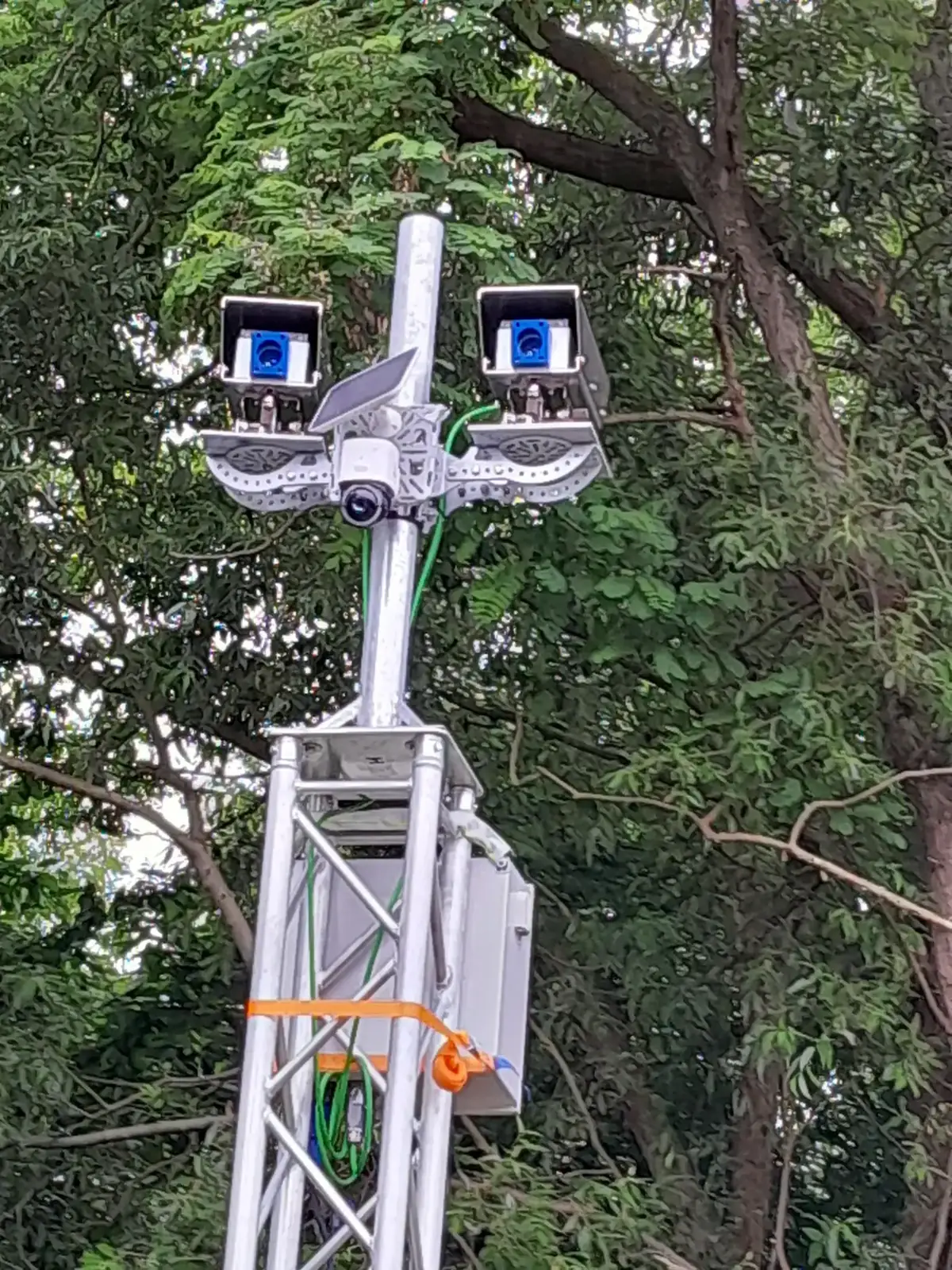
Observe the load-bearing behaviour once the damage has already occurred. Laser-based deflection monitoring captures the geometry of the structure continuously and reports changes that point to a prestressing-wire break. The measurement is non-destructive and contactless, requires no intervention in the structure, and runs on solar power and radio even where there is no mains supply.
Combined with the other measured quantities on the concrete structure, meaning crack widths, moisture and movement, this produces an overall picture. How these quantities interact is described on the page about concrete monitoring.
What remains
Stress corrosion cracking is not a damage you can avert by looking closer. You do not see it. What is possible is to monitor the condition that enables it, and to measure the response it triggers. Together, these turn a mechanism that would otherwise only be noticed on failure into an early-warning system.