

What settlement is
Every structure transfers a load to the subsoil, and the subsoil responds. It compacts, pore water is displaced, and the structure moves down by a certain amount. This vertical movement is called settlement. In a new building it is planned for, it decreases over time and largely comes to a standstill. On soft, cohesive soils, however, a structure continues to settle slowly for years, which engineers refer to as creep.
Settlement becomes critical when it starts again later, progresses faster than expected or differs in magnitude at different points of the structure. Detecting exactly this is the task of settlement monitoring: it determines at defined monitoring points how far a structure has moved down relative to a stable reference point, and shows over time how this movement develops.
Uniform and differential settlement
If a structure settles by the same amount everywhere, its geometry is preserved. The load-bearing structure is hardly subjected to any additional stress. With large amounts, the transitions still suffer: service connections, joints to neighbouring buildings and connections to paths and ramps. Differential settlement is a different matter: if one corner, one pier or one part of a building settles more than the rest, the structure is twisted. Restraint stresses develop, which the material relieves at its weakest point, and that is where cracks open.
Such settlement cracks often run diagonally and widen towards one side. They are frequently accompanied by doors and windows that stick, open joints or visible tilting. Differential settlement therefore also shows up as tilt of the structural element. For the assessment, the absolute amount matters less than the difference between two monitoring points relative to the distance between them. This angular distortion determines how severely the structure is twisted: 2 mm of differential settlement over one metre weighs more heavily than over ten metres. Added to this is the speed at which the difference grows.
Typical triggers for settlement monitoring
Settlement monitoring is usually commissioned when something changes in the subsoil or the surroundings of a structure, or when a structure already shows signs of movement:
- Civil engineering works and excavation pits next to existing buildings. Excavation, shoring and vibrations can affect the subsoil of neighbouring buildings.
- Groundwater lowering. When the water table drops, conditions in the ground change. Rising or falling water pressure often signals settlement and heave long before damage becomes visible.
- Existing structures with suspected settlement. New cracks, increasing crack widths or tilting are a reason to measure the movement rather than estimate it.
- Temporary bridges and temporary structures. They often stand on provisional foundations and must remain stable while in use.
- Railway infrastructure. On sleepers and track infrastructure, even small changes in height affect the track geometry.
In all cases, two things matter: detecting movement while it is still small, and documenting the condition reliably.
Settlement monitoring methods
Which method fits depends on how precisely, how often and for how long measurements need to be taken.
Precise levelling. A survey team uses a level to determine the height of monitoring bolts on the structure relative to a benchmark outside the zone of influence. The method is accurate and well established, but it only provides snapshots. Between two measurements, what happens on the structure remains unknown.
Total station survey. A total station captures survey prisms on the structure in three dimensions. In addition to height, this also makes lateral displacement visible. Here too, the value of the data depends on the measurement interval, unless the instrument is permanently installed and measures automatically.
Hydrostatic levelling systems. They work on the water level principle: connected vessels filled with liquid show differences in height between the monitoring points. This is suitable for monitoring points at a similar level, for example along a basement storey.
Settlement gauges and extensometers. They are installed in boreholes in the subsoil and measure not on the structure but in the ground beneath it. This shows at which depth the soil is compressing. It is mainly required for large excavation pits, embankments and foundations on soft ground.
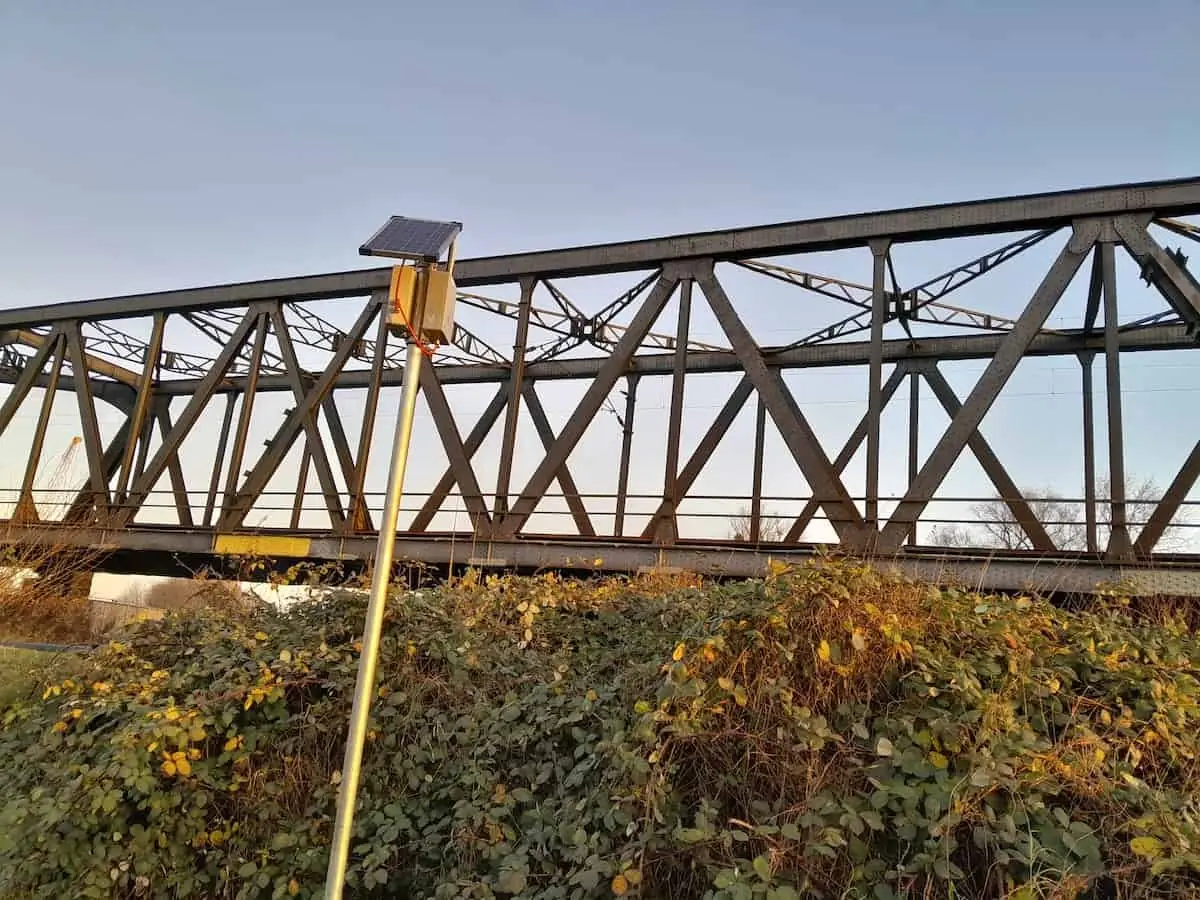
Sensor-based settlement monitoring. Tilt sensors and distance lasers are permanently mounted on the structure and measure continuously. The tilt sensor captures whether and how much a structural element tilts, the laser measures the height. Readings are transmitted continuously, without a survey team having to come out.
Measurement interval and monitoring plan
Settlement progresses slowly, often over months, and it does not accelerate evenly. An interval measurement therefore mainly shows where a structure stands at the time of measurement. Whether a movement has increased between two dates only becomes visible at the next date.
Continuous monitoring closes this gap. Because readings are available at all times, trends can be detected as they develop. With stored thresholds, the system reports a critical development at the moment it occurs. This is particularly important where works in the surrounding area have to be adjusted or interrupted at short notice.
Regardless of the method, every settlement monitoring project starts with a monitoring plan. It defines:
- which structural elements and monitoring points are monitored, matched to the critical points of the structure
- which reference point lies outside the zone of influence
- which quantities are recorded, meaning height only or tilt as well
- which thresholds apply and who is notified when they are exceeded
- when the baseline measurement takes place, meaning the initial condition before works begin
The baseline measurement in particular determines how meaningful the data will be later. Without a documented initial condition, a change can neither be proven nor attributed to a cause.
How Infrasolute monitors settlement
For settlement monitoring, Infrasolute combines two quantities. The tilt sensor is firmly attached to the structural element and records angle changes from ±0.001°. In addition, distance lasers measure the height and resolve settlement down to 0.1 mm. Together, the two quantities give a complete picture of the movement, which makes it possible to separate non-critical settling from structurally relevant movement.
The sensors feature integrated temperature compensation from -40 °C to +85 °C, transmit their data in real time and display it in the online data portal. Via stored thresholds, the people responsible are alerted immediately in the event of critical developments. How the system is set up in detail is described on the page on tilt and settlement monitoring.
Where groundwater lowering may be the cause, groundwater monitoring adds pore water pressure to the measurement. And where settlement cracks are already present, crack monitoring shows whether they continue to open.
What remains
Settlement is a natural process, as long as it levels off and progresses evenly. Settlement monitoring shows when it leaves this range. The earlier and the more frequently measurements are taken, the more time remains to respond before a movement of a few millimetres turns into damage to the structure.